Research methods
A Device for Measuring the Parameters of Bar Motion
English summary of Tyazhelaya Atletika. Ezhegodnik 1982 (Moscow: Fizkultura i Sport, 1982), pp. 69–70: the text is paraphrased, not translated; figures are the original images.
Abridged from Sport Wyczynowy (Poland), 1980, No. 10, pp. 51–56; prepared by G. Sverkunova. The editors describe it as giving immediate bar-motion data in training.
Design
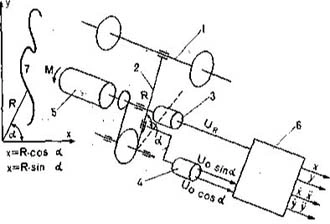
- Free-standing steel housing. On top: parameter selectors, auto-scaling switches for velocity and acceleration, a manual set-up key, the mains switch, and six coaxial outputs (X, Y, Vx, Vy, ax, ay).
- Inside: pulse rotation sensors and conversion electronics.
Principle
- A cord runs to the middle of the bar. The device measures its exit angle α and length R (polar coordinates).
- These are converted to X, Y and differentiated: Vx = dx/dt, Vy = dy/dt, ax = d²x/dt², ay = d²y/dt².
- Auto-scaling sets the recorder signal equal to 5 m/s or 10 m/s², so values are read straight from the chart.
Records
- Bar-path diagrams: quantitative (deviation from the vertical, momentary dips of the bar) and qualitative (smoothness).
- Phase diagrams: likewise; e.g. bar velocity at any height.
- Velocities and accelerations against time.
- Works for any point of the body or apparatus, except very large, fast or impact movements. Well received by athletes and coaches.
Acceleration unit printed “10 m/c” (m/s² meant); the printed ax, ay formulas show “dt” in the denominator.