Weightlifting. Yearbook 1982
The First Olympic Appearance of Soviet Weightlifters: Helsinki 1952
English summary of Tyazhelaya Atletika. Ezhegodnik 1982 (Moscow: Fizkultura i Sport, 1982), pp. 4–7: the text is paraphrased, not translated; figures are the original images.
Background
- Soviet lifters had won the team contest at six of their eight Olympics. The author, who won no title in Helsinki, calls this first victory the most memorable.
- The decision to compete came only in 1951; nobody had Olympic experience, and post-war shortages still affected daily life.
- The USA, then at its peak, had beaten the Soviet lifters in 1946 and 1950.
- Heavyweight Yakov Kutsenko carried the flag at the rain-soaked opening. Lifting took place in the Messuhalli-2 hall.
The lighter classes
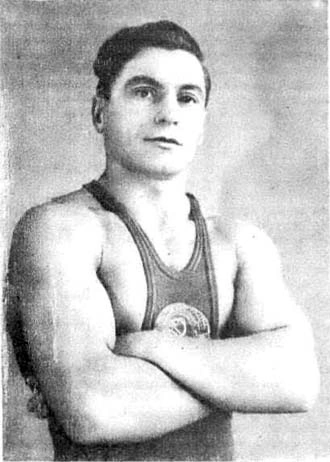
- Bantamweight: Ivan Udodov won the first Soviet gold. Deported from Rostov for forced labour in Germany, he weighed 29 kg at liberation. He later won world and European titles and set many records; he died in 1981.
- Featherweight: Rafael Chimishkyan gold, Nikolai Saksonov silver.
- Lightweight: Tommy Kono won the first US gold; Yevgeny Lopatin silver.
- Welterweight: no Soviet entry; Peter George won US gold, narrowing the Soviet lead.
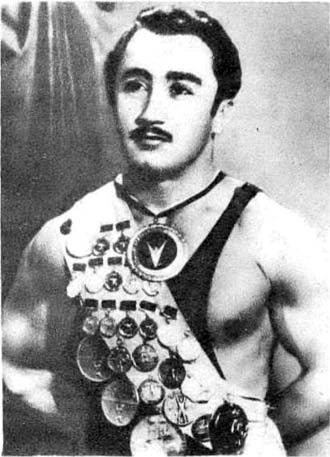
Middleweight: the author's own contest
Vorobyov and Trofim Lomakin were entered. The weigh-in was moved without warning from 1 p.m. to 10 a.m. Both weighed 81.8 kg; the American Stanley Stanczyk was heavier.
Press
- Vorobyov opened at 120 kg; the referee held the start signal about five seconds and he barely completed it.
- A protest by the second American, K. Emrich, delayed Vorobyov's second attempt by almost an hour. He saw it as psychological warfare by US coaches Bob Hoffman and John Terpak; 125 kg then felt like 150.
- On his third attempt at 125 kg the signal was again delayed; he pressed it, blacked out and fell, still gripping the bar.
- Lomakin made 125 kg, below his usual 130. Stanczyk's unclean 127.5 kg, passed 2–1, was annulled on a 40-minute Soviet protest; he pressed again, still unclean, and it counted. Lomakin now trailed by 2.5 kg, Vorobyov by 7.5 kg.
Snatch
All three made 127.5 kg. For Vorobyov, the world snatch record holder hoping for 135, this was a blow; Lomakin relied on his strong jerk.
Clean and jerk
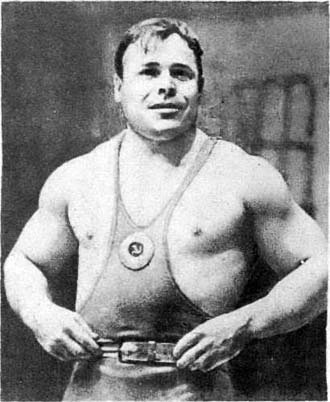
- All made 160 kg. Lomakin and Stanczyk missed 165 kg; Lomakin then made it.
- Vorobyov passed 165: only 170 kg, 1 kg over the world record, could win. His first try did not pass his knees.
- Next he jerked 170 kg, but the "down" signal was delayed until the bar fell. One judge passed it, two failed it; the protest was rejected. French judge Jean Dame refused to continue judging; Carling (Britain), Hokkonen (Finland) and other jury members followed.
- He was denied another attempt, though a lift not passing the knees should not count; a further 40-minute protest failed.
- Result: Lomakin 1st, Stanczyk 2nd, Vorobyov 3rd.
The author concludes that judges could sway even Olympic medals, and that the USSR had no members in the international federations or on judging panels.
Heavier classes and final result
- The US could no longer catch the Soviet team, even if Norbert Schemansky, John Davis and Jim Bradford won two golds and a silver.
- Light-heavyweight: Grigory Novak led the press with 140 kg, but Schemansky overtook him and won.
- Heavyweight: no Soviet entry; Americans first and second.
- Soviet total: 3 gold, 3 silver, 1 bronze; 40 points in the unofficial team contest, 2 ahead of the USA.
The footnote on Udodov's death spells his name "Udalov", a misprint.