Technique
The Structure of the Start in the Snatch and the Clean and Jerk
English summary of Tyazhelaya Atletika. Ezhegodnik 1982 (Moscow: Fizkultura i Sport, 1982), pp. 38–39: the text is paraphrased, not translated; figures are the original images.
Why the start matters
Active work on the bar lasts only 0.6–0.8 s in the snatch and 1–1.2 s in the clean, and the lift must end with the bar fixed on straight arms, so every element, the start included, must be precise. Since Luchkin's first detailed description (1940), authors such as Bozhko, Verkhovsky, Vorobyev, Roman and Sokolov have described the starting position generally or element by element (foot placement, grip and its width, trunk inclination, leg flexion, shoulder position), but no thorough study with modern methods was found.
Proposal
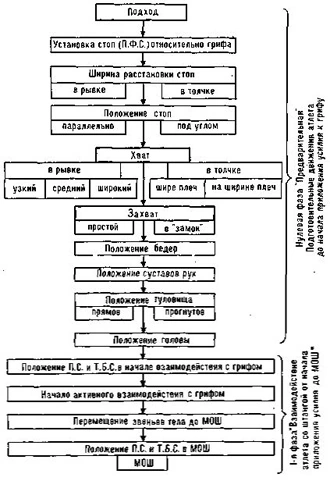
- Lukashev's 1972 division of the lifts into elements, phases and periods began with phase 1, “interaction with the bar up to lift-off (MOSh)”, leaving out the preparatory actions before force is applied.
- These actions should form a separate “preliminary” phase, numbered zero; phases 0 and 1 together make up the “start”.
- The structural scheme below orders all start elements as lifters perform them, for the snatch, the clean and jerk and assistance exercises. It should improve teaching and training; work on it continues.