Technique
The Clean and Jerk Technique of World Record Holder V. Marchuk
English summary of Tyazhelaya Atletika. Ezhegodnik 1982 (Moscow: Fizkultura i Sport, 1982), pp. 30–34: the text is paraphrased, not translated; figures are the original images.
Material
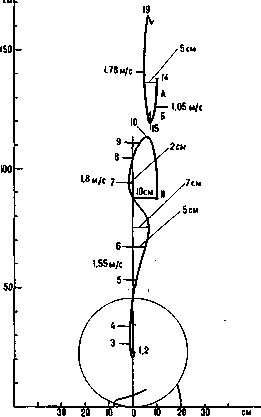
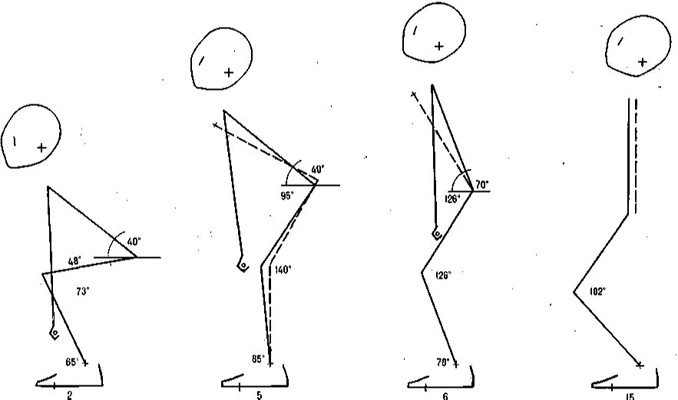
Film analysis of a 257.5 kg clean and jerk by the super-heavyweight V. Marchuk (height 178 cm). Frames refer to the film sequence, positions to Figs. 1–2; “shoulders” means the centres of the shoulder joints.
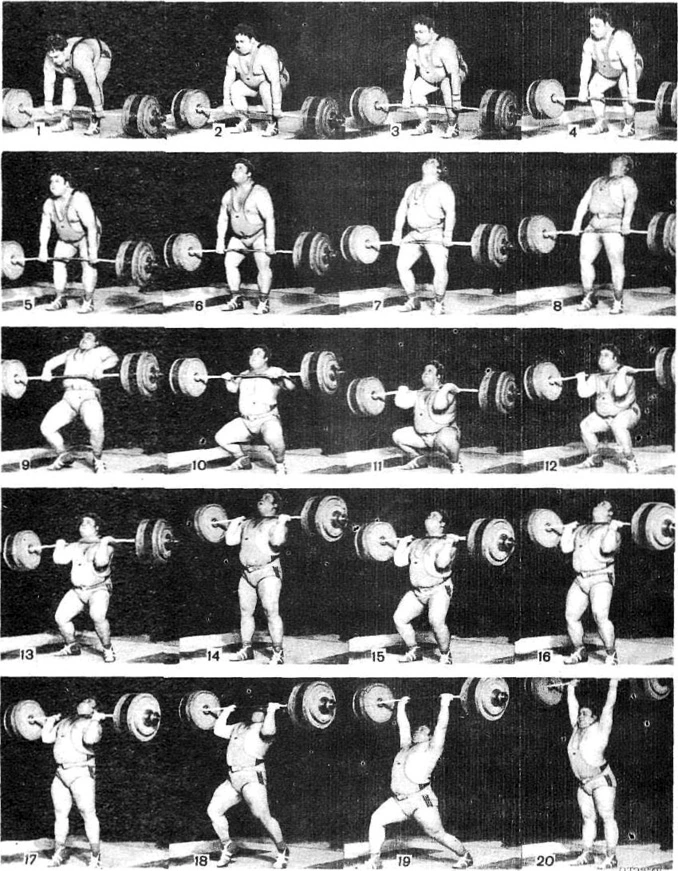
The clean, phase by phase
- Start: feet about hip-width, toes slightly out, bar over the metatarsophalangeal joints, medium grip. He slowly lowers the hips to just above the knees: trunk about 40° to the platform, shoulders ≈ 3 cm ahead of the bar, arms straight, head nearly upright, shins touching the bar.
- Lift-off (0.22 s of force build-up): knee extensors do the work. Unlike other lifters, his shoulders rise straight up rather than up and forward, so the bar rises vertically instead of coming towards him.
- First pull (leg extension, 0.51 s): leg extension stops at a knee angle of about 140° (others ≈ 150°); hips ≈ 95°. The shoulders end 8 cm ahead of the bar, which is at knee level, 52.5 cm high.
- Knee rebend (≈ 0.1 s): vigorous trunk extension drives knees and hips forward and down to a knee angle of ≈ 126°; bar near mid-thigh over mid-foot, shoulders 2 cm ahead, shins at 70°. Between knees and mid-thigh the bar reaches its peak first-pull speed, 1.55 m/s.
- Explosion (0.2 s): legs and trunk extend together onto the toes; bar speed 1.8 m/s. The bar first comes 2 cm closer, then moves up and forward to 2 cm ahead of its starting line.
- Squat under: the arms work actively (flexors, then extensors) to bring the body under the bar; its path curves back into a downward loop; feet go sideways and slightly back. Toe support lasts 0.13 s after the explosion, flight 0.07 s; at landing the bar peaks at 113.5 cm. Absorption (0.25 s) lowers it 26 cm to 87.5 cm on the chest. Squat under 0.45 s; pull and squat together 1.26 s.
- Recovery: from a shallow squat (trunk slightly forward, knees out, elbows high) he rises hips first.
Jerk from the chest
- With the hips not moved back at the start, the centre of gravity lies further from the ankles than is optimal, so in the dip it shifts forward and the bar moves 3 cm forward.
- Dip: 19 cm (10.6% of height), knees to about 102°, 0.46 s; bar speed builds to 1.05 m/s over the first 12 cm (63%, section A), then is braked over 7 cm (section Б); pause 0.06 s.
- Drive: exit speed 1.78 m/s, reached 2 cm above the chest; the bar ends 5 cm ahead of its chest position. He then pushes himself down into the split; the bar travels straight, driven 27 cm above the chest, before he recovers and fixes it.
Distinctive features
- Incomplete shin extension in the first pull: 85° to the platform instead of vertical.
- Trunk extends with the legs: ≈ 40° at the end of the first pull and ≈ 70° before the explosion (others 30° and 60°). First-pull speed is thus higher; the first-to-second phase speed ratio of 100 : 116 puts the emphasis on the first pull.
- Short knee rebend: ≈ 15° of flexion instead of the usual 25° (150° to 125°), so little bar speed is lost.
- Very high catch: 87.5 cm, above the previous maximum of 85.5 cm for lifters of his height. So he pulls the bar to 113.5 cm, 64% of his height — the maximum for this height (average 60%, i.e. 107 cm) — evidence of greater strength than other lifters.
- Outstanding squat under: by momentum the bar would have reached only 100 cm. The extra height comes from his longer toe support, during which he works on the bar, getting under it while raising it. A short flight lets him receive the bar before it gains negative acceleration, and fast absorption limits the drop to 26 cm (22.5 cm with 247.5 and 260 kg) against a previous minimum of 25 cm. This was the key to the record clean.
- Jerk from the chest within the usual optimum; averages for lifters of his height: dip 18 cm, knees 104.5°, drive 27 cm, dip speed 1 m/s, drive speed 1.72 m/s.